The winemaker has a quick cameo (but I assume a much larger role) in this preview for the new documentary: SOMM: Into The Bottle (a follow-up to Somm). I’ll let the trailer speak for itself, but let’s put it this way, Summer 2015 can’t come fast enough! Both Eater and Wine Folly have details!
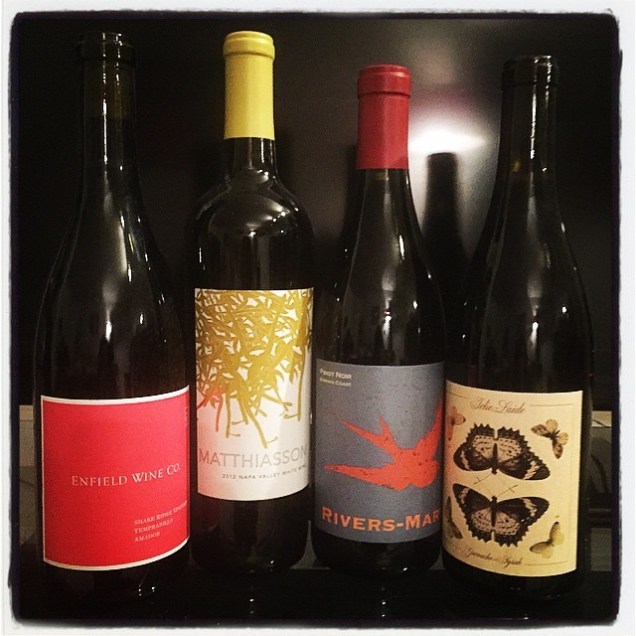
My first #wine delivery of 2015 is all about California. {enfield tempranillo, matthiasson napa white, rivers-marie Pinot and jolie-laide grenache/syrah} #happiness #noterroirsttilt
I found a fabulous everyday, bring-to-a-party, serve-at-a-celebration bottle of sparkling rosé. It’s a Domaine Rolet Père et Fils Crémant du Jura. And for about $22/bottle, I had no qualms about going back and buying a few more bottles (which I’ve now taken to almost every brunch or party I’ve attended for the past month).
It’s from Jura. That’s the French region southeast of Champagne recently described as what wine journalists talk about to gain some “counterculture street cred.” It was also the only bottle from Jura at a local shop. And while picking up some other wines, I bought a bottle out of curiosity.
I decided to serve it to a friend who came over for a festive evening of cheese, meats and wine. The intention was to pour a glass to toast the evening and then move on to some red wines. That plan quickly changed, as we laughed, ate and chatted our way through the entire bottle.
When I brought it to a brunch the following week, a person at the table who declared she didn’t drink sparkling wines, refilled her glass a few times. That bottle was quickly diminished by the table, too.
Here’s what makes the wine worth your while (especially if sparkling wines aren’t your favorite): There are very little bubbles. Those that are there settle quickly and only provide a brief bit of effervescence in the background. It’s acidity balances the tart fruit flavors leaving a dry and crisp finish. While light in body, the fruit-forwardness of this sparkler gives it a solid elegance.
I haven’t decided if this will be my choice for new year’s eve, but I plan to be drinking this many times in the new year. Cheers to 2015!
This morning’s daily news roundup on the Terroirist blog points to this profile on HervéSouhaut, a French winemaker whose wines I’ve only recently tasted. Wine Spectator writer James Molesworth (who I also recommend following on Instagram) sums up these wines like this (added emphasis is mine):
This was my first visit to Hervé Souhaut and Domaine Romaneaux-Destezet, a relative newcomer which has rapidly become a darling among the hipster set for its pepper- and violet-infused unoaked Syrahs.
Does that mean I (too) have fallen in with this crowd? Regardless, I’ve now sipped the St. Joseph Syrah twice, and both times really enjoyed it. The flavors are not overbearing and there’s an elegant not-quite-full-bodied mouthfeel. It won’t stop you if you’re engaged in conversations with friends, but it has enough interest that when you’re ready to take a break from the mindless chit-chat, it will give you something to pay attention to and more importantly, smile.
You know that feeling when you sip a wine and a grin slowly takes over your face while a warmth makes it way down to your belly as you let out a quiet sigh of happiness? Yeah, that one.
If you’d like to know more about these wines, Molesworth does a good job at introducing the reader to Mssr. Souhaut, and discussing the 2013s.
Contrary to my post earlier this week about the “ecology” of oak, these wines do their best to avoid the stuff:
“I just don’t like the taste of oak, and don’t want the wines marked by oak,” said Hervé with a light shrug.
That’s alright with me: Sometimes you feel like an oak, sometimes you don’t.
There’s quite a bit of gunk on this cork, but dark fruit and raisins on the nose combined with smooth tannins and pleasantly balanced acidity make this a very nice sipping #wine on this frigid night. #dreamingofsonoma #winesofinstagram
It’s not just about the flavors that Oak imparts, a barrel has its sort of ‘Ecology’ that adds a lot more to a wine than merely Oak flavorings.
Over on the Wine Berserkers message boards, a new member asked about the difference between mass-produced and boutique wines. Among the discussion, Eric Hall, of Roadhouse Winery in Healdsburg, wrote this simple statement to help the poster understand how barrels provide a different experience than the cheaper oak chips that can often be used in inexpensive or bulk wines.
But you know me and my affinity for words and ways to communicate about wine. So the use of ecology stood out to me. While I always like to talk about how wine is a living, breathing entity, I rarely think of that during its production phase (after the grapes have left their natural ecology in the vineyard). There’s probably more of an argument to be made that it’s doing most of its living and breathing during this stage, but in my mind, the human manipulation of yeasts, oxygen, carbon dioxide and other chemicals or compounds don’t quite feel very natural.
Eric, however, makes a very good observation and is exactly right to call it an ecology. The barrel, which becomes a wine’s home for days, weeks or for many years, usually goes untouched. The wine, lives, breathes and matures in the vessel. Unlike when bottles or stainless steel vats are used for aging, the wood allows for some oxygen to enter. The wood can also age with the wine, sometimes losing many of the flavors it imparts. Depending on the barrel, it may even soften the wine.
It’s in that barrel where the wine can really do its thing — become more complex, develop new flavors, balance its acids and astringency. And it’s the ecology inside the barrel — where molecules and chemicals dance inside the liquid — that helps wine become wine.
While this may just be an “oh, duh,” moment for me, Eric’s response while helping a newbie understand the mysteries of wine struck me as very poetic, and a reminder of how fragile making wine can be.
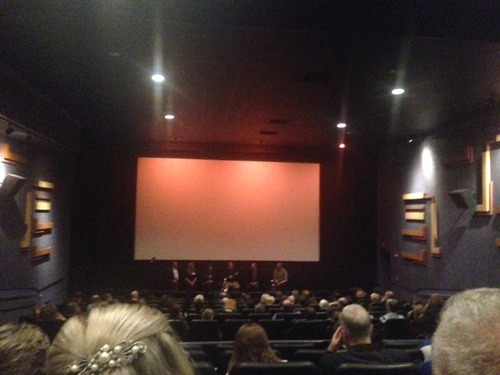
A fuzzy photo I took during the post-movie Q&A with the director and winemakers.
Last night I attended a screening of American Wine Story here in D.C. It’s a documentary focused on passionate winemakers who left their everyday lives to follow their dreams. It sounds a bit hokey, but it wasn’t. And if you’re in love with wine – and the stories behind the bottle – you will completely relate to these people and most likely be in awe of their ability to take such huge risks and work extremely hard and long hours for either very little or no profit (at least in the first decade or so). There’s no denying that these people are in pursuit of their wildest dreams.
The screening I attended was also a fundraiser, and included a tasting of the wines featured in the films plus a post-movie Q&A with some of the the winemakers. Overall it was a great event, and I’m glad I attended. If I were among the organizers, I would deem the event a rousing success.
But nothing is ever perfect, and everyone’s personal experiences are different, so I thought I’d play a game of “the good, the bad and the ugly.”
The Good
It’s a beautifully shot film and it was very fun to try the wines and hear directly from some of the featured winemakers. The focus wasn’t centered on California, but other wines across the country: A lot about Oregon, some Virginia and a little Missouri and Arizona thrown in. During the Q&A, there were some lovely gems by Luca Paschina, the Italian winemaker at Barboursville, who’s been making wine in Virginia for 25 years. He recognizes success in wine is not just about quality, but the relationships you make. That sentiment is actually an underline current in the film – especially during the telling of Oregon’s Brooks Wine. Luca was realistic, too: Passion is not enough, he says, you have to be in the right place. And I’ll add: at the right time.
The Bad
The opening reception was a bit too long, and the Q&A was a bit too short. Also, not all the wine tables were manned by representatives of their brands (although many were). I realize that’s a difficult thing to manage, but it’s a much different experience when the people pouring the wine have intimate knowledge of it. With a price of $50 to attend the screening of a film that is now available on iTunes, I had slightly higher expectations (maybe, a bit too high).
The Ugly
Fortunately, there’s really not much to write in this category. Attending by myself was a bit lonely during the reception and before the movie began. It didn’t help that there was no cell service in the building. It was a cold and rainy night. Many in attendance had gray or white hair, so I felt a little out of place at times. And those who appeared to be my age were there because they were in the wine business. I had hoped that some other younger (and by younger, I mean 30- or 40-something) enthusiasts might have been there. Or maybe I just was circulating in the wrong parts of the room at the wrong times.
But don’t let “the ugly” cloud this post. I’m very glad I went, and really enjoyed the film. This tweet I wrote shortly after sums it all up nicely:
Lots of talk of passion in @thewinemovie. It's like I found my people.
The Genealogy of Wine: A genealogical investigation into the connections between every major variety of wine.
The folks over at Huffington Post Taste kindly drew my attention to this really cool family tree connecting the hundreds (maybe, more?) of wine grapes. It’s fun visuals like this that makes me wish i had tons of wall space to cover with wine info-graphics.
I discovered this great bit of advice while searching Vogue’s archives for wine-related stories (I’ve been trying to wrap my head around the differences between men and women and their relationships with wine — and how that’s portrayed in the media or in marketing, but that’s a post and a subject for another time — although if you want to discuss, use my gmail address: itswinebyme).
This is just pure practical advice. I know I’ve been caught more than a few times with some wine blotches on my lips! And with winter coming, it seems like hydration will be even more important!
The successful wine writer always puts wine on a pedestal, speaks of it in mystical tones. Naturally, one also has to be on that pedestal in order to know about wine, to understand it. Don’t write stupid things like ‘Please join me on my journey to discover wine!’ You don’t want any company on the pedestal. On the pedestal is where the wine writer belongs all alone, gazing down at all those beneath him trying to clamber up the pedestal. From up there, your arms firmly around the mystery and majesty of wine, with your reputation and false humility, you can cast judgments and ratings and scores down upon the masses, as the Greek gods tossed lightning and fate down at mere mortals. And they have to accept it, they don’t have to like it.
Very funny advice this morning from Ron Washman (aka TheHoseMaster of Wine) published on Tim Atkin’s website. The entire column is worth a read, especially for those who appreciate good writing and are trying to understand how the wine community communicates with each other, and to newer audiences.


 It's Wine By Me!