A few iPhone pics from last weekend’s Spring #lambfest, cook-out and wine bash (be sure to scroll to the right – and yes, the picture above is beef, not lamb). Highlights included:
A cooler of bubbles with the super quaffable Ultramarine rosé, a 2005Gaston Chiquet Special Club Brut Champagne Blend, and the Jacques Selosse Initial Grand Cru Brut Blanc de Blancs. (The Jacques Selosse was the first pour in my glass as I walked out onto the deck and it stopped me in my tracks).
Food included lamb shoulder (not pictured) and New York strip steaks, a smoked mushroom polenta and for dessert an English pea cake with fresh pea shoots to garnish. There was also an amazing baked dish consisting of morels, fiddleheads and asparagus: the combination of crisp veggies surrounded by lusciousness felt like a mix of springtime and a warm blanket for your soul (and no, I’m not exaggerating).
There were significantly more wines than what’s amassed in these photos. I brought my favorite Red Car rosé, which while perfect for this hot summer-like day, was incredibly pedestrian compared to the 1988Chateau Latour that graced our meal. Later in the evening, I sampled both a Hervé
Souhaut Le Cessieux (pleasantly photobombing this 2004 Cornerstone Howell Mountain Cabernet) and the cab. My palate much prefers the Souhaut, but was too compromised by this point in the evening to allow me to fully appreciate one of my favorite producers.
Good times, good food, but more importantly good people – this is what life is all about!
I’m a little bit too excited to see the New York Times take on IPOB, so apologies if
you follow my other social media accounts and have seen this already. And if you’ve diligently read this Tumblr, you probably recall this post I wrote a few months ago.
But this profile really does a great job introducing readers to the concept, the winemakers and the controversies around it, while providing a good understanding of Robert Parker’s influence on the industry – especially in California.
So Maxim Magazine – the publication known for publishing provacative photos of models and celebrities – posted a piece that doesn’t seem quite right for its demographic. But I’m glad they did.
If someone told me they were publishing a piece on women sommeliers – I would have expected something much different, if not the opposite of what it did.
The story actually tackles the sexism that wine professionals like Heidi face, rather than glorifying them. So I’m posting it here, in hopes of giving it a wider audience. As I suspect, the many women who would also be interested in this piece, may not ever find it. If it hadn’t been for this tweet, I never would have.
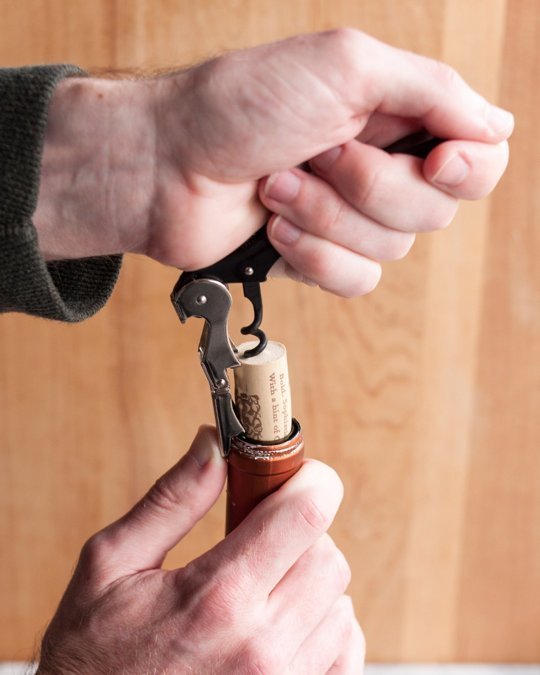
After much practice, I’m finally to that point where I can at least get half the cork out of the bottle before it breaks (sigh). The most important tip I’ve learned so far: Anchor the hinged arm and keep it there with your thumb (just like the photo above).
If only I had discovered this great step-by-step guide from the folks at The Kitchn blog sooner! So I’m posting it here for my own reference and as a public service announcement to those who fumble like me.
The only piece of advice that’s not included in their guide: If you’re short like me, find a lower surface than a kitchen counter (or a high-top bar) to stabilize the bottle.
I’m doing my best to diversify this tumblr as best I can, but when Lettie Teague of the Wall Street Journal keeps churning out one interesting column, after another, it’s hard not to share.
They say if you try something enough times, you’ll develop a taste for it and even begin to enjoy it. That’s happened with certain foods for me and I figured that would be true for certain wines – and specifically Cabernets. It’s the one wine I purposely don’t drink much of. Before you think I’m crazy, I have a valid reason, that I wrote about here. But being the open-minded gal that I am, I’ve done my best to keep tasting.
This past weekend, the wine group I’ve become a part of declared this week as Cali Cab and Bordeaux Day. Perfect, I thought: A chance to try a wide array of these wines, with the hopes I’d find one or two I like. I could then – maybe – pin down a specific vintage, age, producer or location. Since I’ve had some positive experience with cabs, like this 2006 Corison, I’m on a quest to classify them. If only it was that easy.
Our Cab and Bordeaux expert of the group kindly saw this day as a challenge for me and he pulled three wines from his locker and poured them blind for everyone to taste. He elegantly labeled them “One,” “Dos,” “Trois.”
(A blind study in Cabernet wines – bottles behind the decanters are not what’s in the decanters / Photo by me.)
My first impression of One, was that this was a classic California Cabernet. Fruit forward, rich, full-bodied. And then boom, I’m hit with green pepper (and maybe there’s a bit of cassis, too). I drank my pour, but I was eager to move on to the next. Dos turned out to be my favorite. I enjoyed it not because it was missing those green backend qualities, but because there was so much enjoyable chalk and gravel and dirt, that those flavors made up for the bitter finish. Trois was pretty. It was lighter than the other two and felt similar to Dos. But I think the lighter quality of the wine didn’t quite diminish the bitter flavors like they did for me in Dos.
When the wines were revealed, any confidence I had in ever distinguishing the difference between French vs. California Cabernets went out the window.
(The wines revealed/ Photo by me.)
Yes … One was a Bordeaux, and Dos and Trois were California.
And yes, I snubbed my nose at the 1999 Chateau Palmer Marguax. Actually, I take that back – I enjoyed the aromas wafting from the glass – I snubbed my tastebuds. What surprised me even more than misidentifying the country, was I have strong memories of enjoying the earthiness found in a 2008 Alter Ego, also produced by Chateau Palmer. Dos was a 2001 Beringer – a single vineyard from Steinhauer Ranch on Howell Mountain in Napa Valley (not the kind you find in the grocery store); and Trois was the oldest, a 1997 Jayson Bordeaux blend from Napa Valley.
I’m nowhere closer to enjoying Cabernet to the level that I can a Burgundy, or a Syrah, or most other wines, but this was a fun endeavor. I brought home the remaining bottle of 2010 Hope & Grace Stags Leap Cabernet that I contributed to the afternoon. My impressions of it yesterday was a lot of anise (black licorice) and herbaceousness. I sipped it, but had I not received it as part of a wine club shipment, I probably would have never paid for it. Twenty-four hours later, it’s much more enjoyable to me. Those flavors have tempered a bit and some chocolate subtleties have begun to appear.
So what are my takeaways? It’s time to try these wines paired with a delicious steak to see if that helps me. And while it would have been great to identify which direction I should go to look for Cabs I can appreciate just sipping, I can’t deny it wasn’t a lot of fun trying!
Just like any good wine lover, when I hear the word Burgundy, my ears perk up, my eyes widen and my tongue may even start to salivate. Its reputation, its history, the delicate winemaking and strict rules it must adhere to – it has all the romance and passion that’s wrapped into the story of wine.
So when I received an invitation to try a line-up of 2012 Burgundies from MacArthur Beverages, it didn’t take long for me to agree – especially since I’ve had limited exposure to it. Not just this vintage, but Burgundy in general. (And yes, I warned them I was an extreme amateur before accepting the invitation!)
The tasting – which took place in the back corner of the store with the bottles resting on a shelf held up by wine barrels – was on a Monday night and very casual. Phil poured from six wines, ranging in price from $22 to $220. But it wasn’t the tasting of different price points which excited me. It was the opportunity to comparatively taste all the traditional classifications of the AOC against each other: From regional, to village, to Premier Cru, and up to a bottle of Grand Cru. (And yes, I realize the wines will most likely go up in price depending on its classification – but that’s not the point of my excitement here.)
The lineup of wines poured at MacArthur Beverages on April 20, 2015 | Photo by itswinebyme.
Here’s my takeaway: All six wines were beautiful in their own right. There was nothing offensive about them and I’d be happy sharing any of these bottles with anyone. (But then again, I’m sure they were chosen because they were fine examples of the vintage and terroir.) I’m not well versed in vintage variations, so I can’t say how these compares to other years. It was interesting (to me) that I didn’t get that typical “Burgundy funk” on the nose until I reached the last two wines (we tasted in order of classification, but for fun – I then tasted in reverse order as a way to revisit some of the pours). This won’t be a traditional review – I’ll leave that to the other moreexperienced palates who were there.
These are the wines we tasted (the photo above is this order from left to right):
* 2012 Joseph Faiveley, Bourgogne ($22): A beautiful, bright floral, fruit-forward nose. As a California girl, it reminded me a bit of Sonoma Coast’s Littorai (and while I realize that Littorai emulates Burgundy – not the other way around, it’s where my wine journey started, so inhaling this wine took me to that experience). At $22, it’s a wine that’s easy to share with anyone – whether they understand wine or not.
* 2012 Joseph Drouhin, Cote de Nuits – Villages ($25): My very limited note taking during the tasting has the words “meaty” and “pepper” written down, next to this wine. Unlike the first wine, there was a bit more structure. Of all the wines, this was the least memorable to me. I didn’t taste this a second time like I did the others. Is that saying something about this wine? Maybe.
* 2012 Domaine Joblot, Clos du Cellier aux Moines, Givry Premier Cru ($45): This appeared to be a crowd pleaser, or maybe just everyone was curious enough to keep going back to it. For my inexperienced Burgundy palate, this was the first wine that seemed more like traditional Burgundies I’ve tasted before. The wine appealed to my love for earthy qualities, and it was significantly deeper than the first two.
* 2012 Louis Jadot, Domaine Gagey, Beaune Les Greves Premier Cru ($50): Compared to the Joblot, I didn’t taste much of a difference. When Phil asked my impressions, the first thing I blurted out was “chewy tannins,” which overtook much of the fruit. That’s not necessarily a bad thing. And it’s one of those wines, I’d love to put in a decanter and sip over the course of the evening to watch it evolve. (Remember, if you’re itching for more traditional reviews from the same tasting, go here and here.)
* 2012 Domaine Heresztyn-Mazzini, Gevrey-Chambertin Les Champonnets Premier Cru ($100): Finesse. At this point in the tasting, I had pretty much resigned myself to only jotting down one word per wine to help me remember it. As I put my nose in my swirled glass, that Burgundy funk reared itself for the first time. But when I took a sip, despite lots of bursting complexity, I took a deep breathe and realized the difference with this wine was it had a very elegant melding of its flavors. About 10 minutes later, I overheard Phil also describe the wine with the word finesse while talking to someone else – so don’t just take my word* on it. (*Note: I’m 95 percent sure he was referencing this same wine. Either way, I’ll stand by my impression.)
* 2012 Domaine Faiveley, Corton Clos de Cortons Faiveley Grand Cru($220): Phil was quick to point out that this is the only Premier Cru that includes its Domaine’s name on the wine. Is it a sign of confidence? Is this wine that special or different? Is it a marketing ploy? I failed to ask those questions. As the only Grand Cru in this lineup, it’s rich complexity was to be expected. What I didn’t expect was the wine tasted backwards on my palate. On first sip, it seemed slightly flat, but then the backend literally bursted in my mouth and the finish went on and on and on. I knew I was tasting something special, I only wish I had the experience to know how this wine would evolve with age.
Whether guided by fear or cheapness or the feeling of unworthiness, the people who choose not to drink wine by themselves are, in my opinion, sacrificing an opportunity to experience pleasure (and maybe even meet a fellow wine lover as well).
Somehow my little tumblr was noticed and MacArthur Beverage invited me to a wine tasting of 2012 Burgundy. I’ll write up my impressions in a larger post soon, but in the meantime it was fun tasting through all the classifications. #wine #winesofinstagram #burgundy #wineporn #grandcru (at MacArthur Beverage)
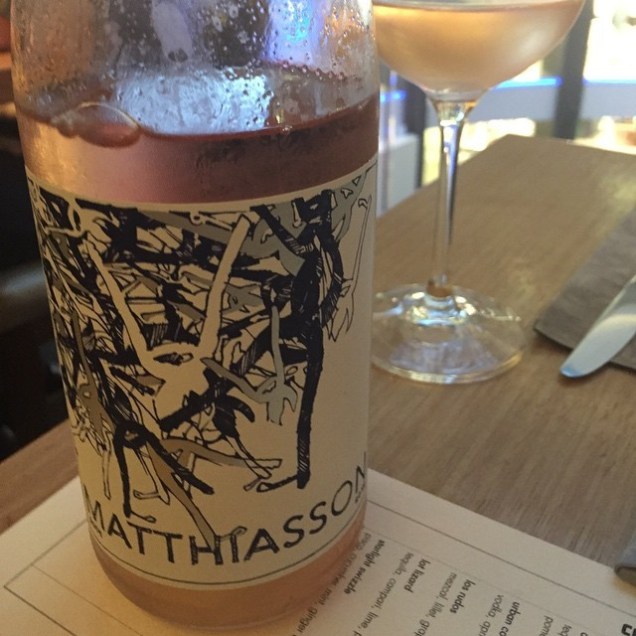
I found springtime happiness on the wine list (at Range).
Over on the delectible app, I gave this a 9.4 and wrote: This 2014 was alive with so much flavor. A medium-long finish that kept popping different citrus flavors after tart strawberries. Loved this!
I haven’t gushed about a wine in a while (or maybe I have… but that 9.4 score is definitely on my high end of what I usually gvie for wines that I truly enjoy) and I rated it after we completed the bottle. So when I woke up this morning I wondered if my enthusiasm for this wine was really deserved? And I’m happy to say, it does!
This was one of those times where the exprience and surroundings while tasting the wine influenced everything about my interactions with it. Whether others agree if this could be the rosé of the season or not doesn’t matter: Drinking this wine on that night, sharing it with a friend who also drew pleasure from it, and eating some fabulous food all contributed to its deliciousness. Just the way every wine experience should be.




 It's Wine By Me!