If you don’t follow Jasmine Hirsch on social media, then you missed a pretty spectacular Instagram post. I’ll let the caption and photos speak for themselves, but if you’re just as fascinated by the winemaking process as I am, this will be quite a treat:
wine
‘The Last True Thing’
I think of wine as sort of the last true thing. It’s so utterly simple, and anyone who loves wine knows how transformative it is. I’ve always been attracted by that almost archetypal pull of wine. I like that idea philosophically and emotionally, and I like the mystery of it.
– Karen MacNeil, author of The Wine Bible
Forbes contributor Cathy Huyghe interviewed MacNeil about how she wrote and now revised her 14-year-old book, which is an impressive encyclopedia of the wine world. It’s an interesting look into
MacNeil’s process, and I was pleasantly surprised to see her dedication to words was just as emphatic as she was to the wine. Read the full story here: How To Write The Bible Of Wine: Karen MacNeil On The Craft Of Writing .
The Rise of Female Sommeliers
Thanks to winewithkristen for posting this story and bringing it to my attention!
Here’s my favorite paragraph of this story:
Given the general public’s recent infatuation with the profession, it’s safe to say we’ve officially transitioned from the age of the stuffy sommelier to that of the casually hip “somm.” An exchange that once involved a highly formalized set of rituals (pour for the man to taste first, never leave the bottle on the table) now takes place amid the blare of rock music in wine-centric restaurants like Manhattan’s Pearl & Ash or Racines NY, where rather than wax poetic about Latour or Lafite, your somm will likely evangelize about the sherry renaissance or recommend some offbeat natural wine from the Loire.
It’s a great summary of the renaissance happening in the wine world. And it’s certainly the energy I’ve been feeding off of in my own discoveries these past few years. But I have to wonder if Zachary Sussman is suggesting that the less “stuffy” and more “casually hip” state of the industry is a reason for the rise in more women entering the field? It’s probably made it easier. But even if being a sommelier was still quite a formal profession – in today’s modern environment – would a lot of woman still be shut out?
I don’t have an answer. Just something to think about.
Chenin Blanc Makes an Audacious U.S. Return
If I don’t have rosé in my glass this summer, and you spy me sipping something white, it’s probably the Sandlands Chenin Blanc. That’s why I was thrilled to see Eric Asimov’s column today and the nice mention and quote from Sandlands owner/winemaker Tegan Passalacqua.
I’m still getting to know the grape and reading Asimov’s story gave me a great introduction while also talking about its resurgence here in the U.S.
Chenin blanc, the white grape of the central Loire Valley, is one of those grapes achieving new life in the United States. Once widely planted in California, it had largely disappeared from fine wine regions by 2000. In the last few years, though, at least a dozen California producers have started making chenin blancs, joining a handful who never stopped, along with producers in Oregon and New York.
Because of its great acidity, chenin blanc is a grape able to make wines bone dry or unctuously sweet yet fresh, with an entire spectrum in between. It has the ability to transparently display its place of origin, to age for decades and to tantalize not just with complex aromas and flavors but with a seemingly paradoxical texture that can be thick yet delicate, rich yet light.
Most of what I’ve learned in the past year has come from the advocacy of Pascaline Lepeltier, the wine director at Rouge Tomate in New York, who gets a nice shout-out at the end of the column. It’s exciting to see that she’s working on her own project:
She has her own chenin blanc project: a plan to plant a few vines in the Finger Lakes of New York in partnership with Bloomer Creek Vineyard.
#NPRReads: Considering The Language Of Wine And What’s In A Toddler’s Mouth
A little bit of self-promotion. I recently sent out this tweet from my verified work account:
…and the NPR Two Way blog editors liked it so much, they included it in the weekly round-up of what NPR staffers are reading.
When I took WSET claseses late last year, one of my goals was to finally learn how to communicate more effectively about wine. And while I certainly advanced my knowledge, I realized I still had a long way to go. So, it’s a nice validation to see The New Yorker tackle this topic.
Click on the link at the top of this post (or just click here) to read what I wrote to our NPR readers about the piece.
I really enjoy introducing more people to wine-related ideas and information, so I’m a wee-bit giddy I expanded my reach this afternoon.
Read it here: #NPRReads: Considering The Language Of Wine And What’s In A Toddler’s Mouth
And Speaking Of Sean Thackrey…
So the man I complemented in my last post for dutifully making wine to “irritate the Wine Police,” has explained his philosophy in an open letter he sent to Food & Wine in response to Ray Isle’s “Wine’s Nastiest Feud” column.
It’s more back-and-forth pointed mostly at the In Pursuit of Balance (IPOB) movement. But I found it interesting because it provides insight into Sean Thackrey’s out-spoken personality.
In Down with Wine Dogma, Thackrey calls adhering to certain rules, like creating lower-alcoholic wines, a fad similar to what you find in the fashion world. He writes:
So what’s the point of dogma in all this? Since no one disputes that excellent wine can be made from grapes comparatively lower in sugar, what is the point of arguing that this is so, when no one argues the contrary? Methinks someone’s marketing guru doth protest too much.
If what you’re making really is all that delicious, there’s no need to demonstrate the limitations of your palate by claiming that all wines made with one or two percent more alcohol content are undrinkable; this is too perfectly stupid for comment. Pour what you’ve actually made as wine, so that we can all see how it—rather than your PR bling (i.e., we’re all about subtlety and intellectual complexity and general all-around Frenchness)—actually tastes in the glass.
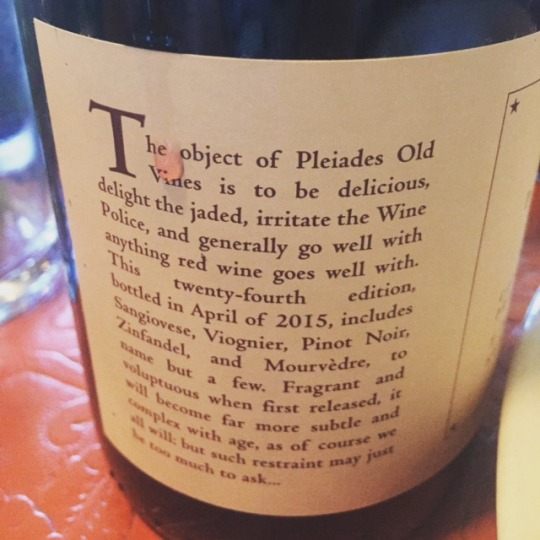
Food & Wine also published a Q&A with Thackrey where Ray Isle asked him specifically about his descriptive wine label:
You’re not a guy who’s short on opinions. The label on your red wine Pleiades says that its purpose is to “delight the jaded and irritate the Wine Police…” Who are the “wine police”?
Anyone who puts restrictions on what you’re supposed to be able to enjoy. Like the idea that if a wine is 15 percent alcohol, it’s undrinkable—it’s hot, overextracted, raw, a fruit bomb, doesn’t show any subtlety, isn’t French and so on. Give me a break! Just taste it first, OK? People with those kinds of absolute preconceptions, they’re part of the wine police.
What it all comes down to – on both sides of the IPOB-debate – is making good wine that people want to enjoy. But how do you get your brand out there ahead of the others? The IPOB winemakers are using each other to propel their wines, while Thackrey is using his blunt label-writing, his non-conformist attitudes and his opportunity to have his story told in Food & Wine. They’re both marketing methods, right?!
For a bit more about Sean Thackrey, I discovered this short video while Googling.
Meditating On Wine
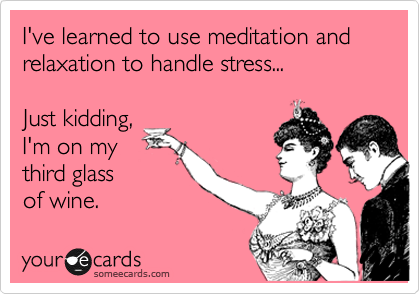
There’s no question that wine (or any bit of alcohol) is a wonderful (although not always healthy) way to de-stress. But after spending 30 days with the Headspace app and learning the basics of how and why to meditate – as well as a new understanding on meditation’s effects on the brain – it’s a no-brainer (pun intended) to understand the similarities between a serious wine drinker sipping their favorite juice and a meditator taking a break from a busy day.
(And, no! I am not writing this as a justification to use wine instead of meditation – just showing the parallels – and *maybe* suggesting that in cooperation, the two practices could lead to *some* extra mental well-being.)*
A mindful practice means focusing on the present. To do that, you have to engage many of your senses – feeling, hearing, smelling – on what’s happening in That. Very. Moment. By doing so, your senses awaken, and in the case of what this app teaches – it lets you have a little more “headspace” so you can have a clearer, calmer and hopefully happier mind.
What I’ve realized is that drinking wine can do the exact same thing – even before the alcohol gets into the bloodstream and provides that temporary chemical escape:
- Swirling – noticing the color and the weight of the wine.
- Sniffing – inhaling the nuances of aromas that emanate from the glass.
- Tasting – identifying the flavors and feeling for the acid and tannins that jump around your tongue.
When you’re doing those things, you’re completely focused on something that’s only purpose is for pure enjoyment. There’s nothing else to think or fret about. It creates a peaceful mind, and with homage to Billy Joel, let’s you forget about life for a while. Ommmm.
*Disclaimer – I have absolutely no medical, health or wellness training. I’m just a girl, trying to put all the pieces together and find some happiness.
A Mini Vertical of Red Car Rosé

Last year, the majority of the rosé I ingested came from Red Car. The Sonoma Coast winery best known for their Pinot Noir makes an elegant and crisp quaffer that goes down incredibly easy on a hot summer day (or at an IPOB tasting). I finished every last bottle I had, so in time for a recent BBQ I scoured the Internet in search of some more. I purchased a few 2014s from a New York store and was very happy. A few days after the event, a friend found some 2013s at a local D.C. wine shop. And this past Saturday, we put them together for a side-by-side comparison.
Conclusions were pretty simple: 2013 was refreshing and light and included some yeasty notes (a flaw? part of the aging?) but had lost some of it’s fruit (which isn’t necessarily a bad thing). 2014 was also refreshing, and had some good tart notes with a bit more body.
So my amateur assessment is there’s no reason to keep these bottles around past their seasons. That’s a good thing – because at least in my house – those bottles won’t stay very long. But if one happens to get lost in the fridge and reappears the following year – enjoy the surprise!
Editing to add: a nice little response from Red Car! Thanks for taking a look and weighing in!
Infographic: The Cost of Wine
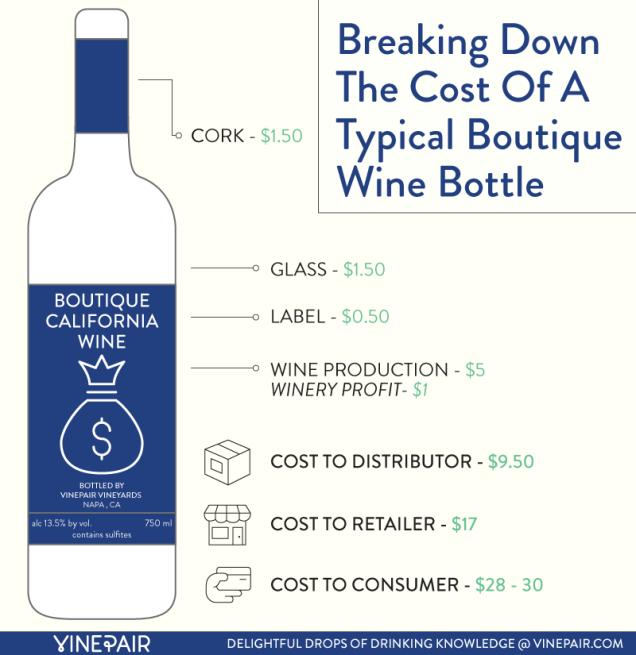
Infographic: Why Some Wines are So Damn Expensive – Breaking Down the Cost of a Bottle Of Wine – VinePair breaks down the costs, not just with the graphic posted above, but with a story that takes you through the entire system.
A Pinot … Noir
If you don’t know about Maureen Downey, you should. Often called the “wine detective,” she’s a leading authority on wine fraud. I won’t go into too much detail here because you should just read this piece. It nicely weaves together an update on the French Laundry wine heist with a profile of Downey’s expertise.
 It's Wine By Me!