
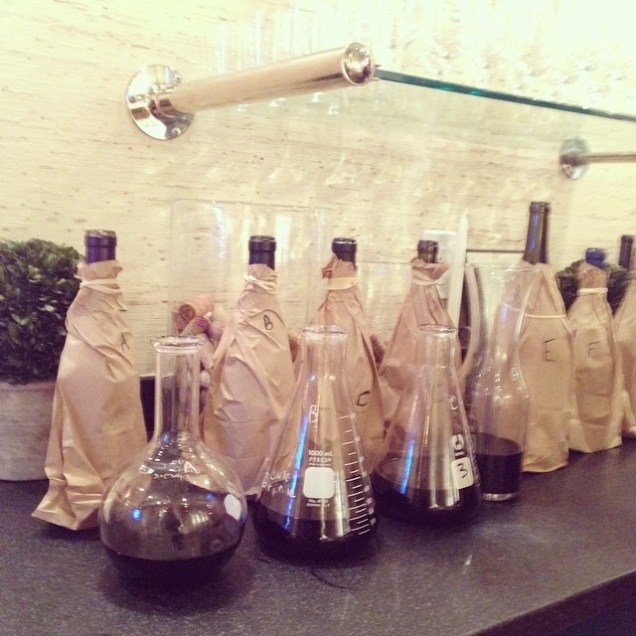
Since we chatted about Rieslings in tonight’s #WSET2 class, here’s a #tbt to earlier this month when we drank this prior to the blind Syrah party. 🍷
Since we chatted about Rieslings in tonight’s #WSET2 class, here’s a #tbt to earlier this month when we drank this prior to the blind Syrah party. 🍷
I’ll admit, one of my guilty pleasures is watching E News when I get home from work. And I’ll admit, I’m a fan of Giuliana Rancic. But when I first saw this story in my Google newsfeed, I was ready to roll my eyes. Then I realized, even though I’m a woman, I’m not the market audience for her newest venture:

That’s right, those are four single-serving wine cups stacked as if they’re one bottle. Aesthetically, the design is very pretty and contemporary. And I do love the thought that it’s a way of being able to save the rest of the bottle when you’re in the mood for just one glass.
I have no doubt there’s a market for these, especially among those who are looking for the alcohol benefit in a nice tasting glass of wine at the end of the day. It may even prove to be a good, accessible gateway into the world of wine for millennials.
But that’s not me, and I have to remember, just because I’m not the market for a particular part of the industry, I shouldn’t be quick to judge. It will be interesting to watch and see how these do.
(Photo: Courtesy XO, G Wine via EOnline.com)
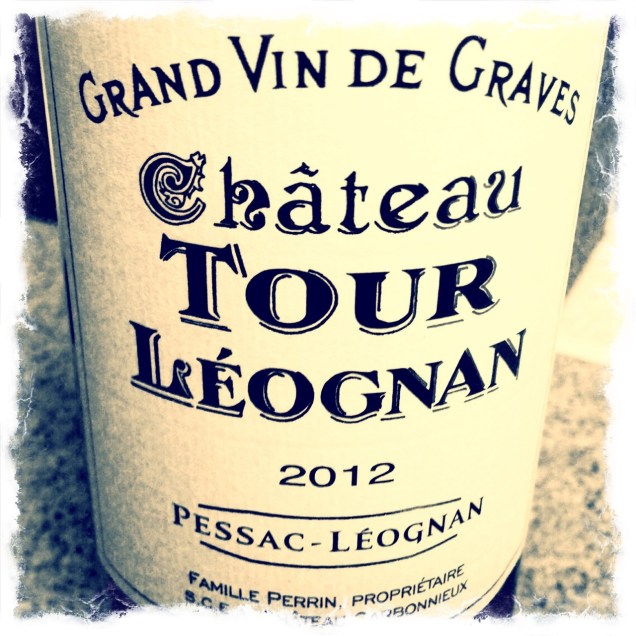
Learn About Wine With Me – White Bordeaux Wine Labels
This may or may not become a regular feature. I like the idea of writing through a specific topic from my class. It helps me better understand the lesson, allows me to stretch my writing fingers and maybe you, dear reader, will find what I have to write about interesting. So I’ll start here, and we’ll see if other topics naturally present themselves in the same way. If you spot a factual error or you’re confused by something I’ve written, contact me: I’m itswinebyme on both gmail and twitter. I reserve the right to come back and re-edit this a million times, as I work through the learning process. 🙂
I love buying wine. It gives me the same kind of happy excitement as when buying new shoes, or a new purse, or anything on a New York City shopping spree. So when the instructor of my WSET class pointed out a specific kind of White Bordeaux we should try, I immediately ran to MacArthur’s. One of their experts selected the label above and told me at $20/bottle it was a good entry level version of this particular wine to try. I haven’t opened it yet, but I figured this would be a good instructive opportunity to really understand the parts of a French wine label. I’m mostly writing this for my own learning purposes (and attempting to do so without my notes). So here’s what I think each element of this label tells us (starting at the top and moving to the bottom):
To make understanding French wine labels even more complicated, there are other quality indicators not listed on this particular wine, such as Cru Classé, which signifies the best wines, according to a classification system created by the French government in 1855. But that system only applies to Bordeaux, so if you’re looking at a French wine label from Burgundy and see terms such as Premiere Cru or Grand Cru, that’s a different designation combining a quality rating and ensuring the grapes are from a single vineyard. Does Cru Classé have to be single vineyard? That I’m not sure about. But since most Bordeaux wines (red and white) are blends, I’m guessing the answer is no.
I’m always uncomfortable about publishing posts that may have factual mistakes. But writing this has taught me there’s still quite a bit I need to learn. If that means buying and enjoying more wine, I’m not going to complain!
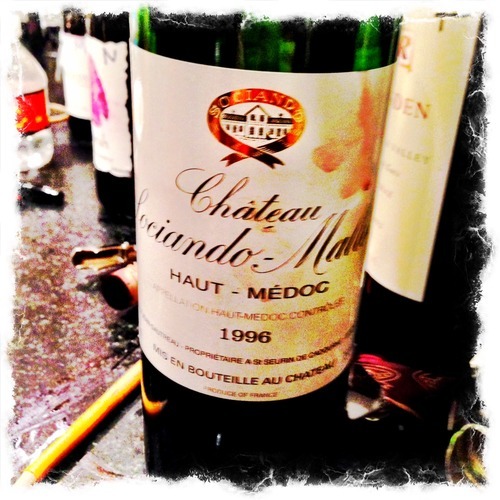
(Photo: A 1996 bottle of Chateau Sociando-Mallet bottle from Haut Medoc, in Bordeaux. It was opened at a gathering I went to last week. Little did I realize, later that week I would be learning about the region. )
Last night’s class was all about varietals: Cabernet Sauvignon, Chardonnay, Sauvignon Blanc and Merlot. But it’s impossible to talk about those grapes without lessons in winemaking, climate and geography. It served as a wonderful reminder of how well-rounded studying wine can be.
As I mentioned last week, I don’t want to rehash my classes, but I do think it’s fun to leave behind some random facts (not necessarily part of the lesson plan). Here are a few from last night:
Probably the most important take away from this class – not related to the formal lesson plan – is that it confirmed my general dislike of many Cabernet Sauvignon and Bordeaux (red) wines (we tasted both a Bordeaux and a California in class). Even when blended with other grapes. Sadly for now, those green bell pepper flavors don’t agree with my palate. I’m not going to give up on them, and with food pairings and age, maybe I’ll eventually grow to like them.
As for that empty Bordeaux bottle I posted at the top of this page, I did enjoy the wine, but I didn’t ask for a second glass. Instead, I reached for some Burgundy.
Cheers!
My talented friend tballardbrown is working on her creative writing by using writing prompts. Today’s word is oak, so she decided to use it in the context of wine. Since she’s well aware of my wine obsession she asked me to give her a wine description that included oak. I’m honored to say she incorporated my two sentences (written, not really knowing what the story would be about) in her story below. While the scene she wrote works on its own, read the entire story she’s building here.
I got a chance to meet and fellowship with some black women writers recently and that has lit a fire under me to start writing more, not just for work, but for myself as I used to do in the not-so-distant past. To keep me accountable, I’m posting some of it here. Be gentle. I’m using writing/blog prompts from Jade Walker (@jadewalker) and oneword.com.
COPYRIGHT © 2014 Tanya Ballard Brown. All Rights Reserved.
Today’s Prompt: Oak via oneword.com
She wasn’t ready to end the Gchat conversation, but had to walk away for another damn meeting. She doesn’t hate her job, but the work isn’t as exciting as it used to be. She had abandoned her creative outlets — painting, writing, acting — but needed to get back to doing at least one of them. Soon.
Her boss drones on about something and she checks her watch. She’s supposed to meet Sidney at noon. The meeting wraps up quickly for a change, so she grabs her bag and takes a cab to Penn Quarter.
Rasika is busy but not crowded when she walks in. The hostess greets her and once they figure out Sidney isn’t there yet, she sits on the banquette in the bar area and orders a glass of California Chardonnay. Surprisingly, it isn’t overly oaked, but hints of vanilla and baking spices emanate from the glass. On taste, it provides a smokey, buttery smoothness, helping to relax her.
Her mind drifts back to the aborted Gchat conversation. She smiles a little thinking about how they used to have naughty Gchat conversations all day and then come home and spend all night doing the stuff they had messaged about.
“Hey girl! Sorry I’m late,” says Sidney, who is never on time ever for anything ever never. As usual she’s stylin’ and profilin’ in red and black Prada Crisscross Molded Wedge sandals, perfectly tailored black slacks and a red houndstooth pussybow blouse, every hair in place in her topknot, small ruby studs in her ears. Sidney tosses her hot cherry-colored Alix bag on the table, settles in and orders a glass of Cava.
“So, how you are you doing sweetie, catch me up,” Sidney asks.
“Girl, nothing has changed. Nothing,” she says. “No backward movement, no forward movement. In a holding pattern right now, I guess.”
“I thought you guys had agreed it was time to see somebody, what happened with that?” Sidney asks before taking a sip of her wine.
“He says he needs to think about it some more,” she says, while signaling to the waiter that she needed another glass of the Chardonnay. “I can’t make him go. I’m feeling drunk already, though, so let’s order.”
(Ed note: My good friend over at It’s Wine By Me helped me get the wine stuff right today since I don’t sip the grape much beyond Prosecco or Cava)
Photo: Rasika by methTICALman
This just crossed my screen and it couldn’t have come at a better time!

Original Source: Wine Aroma Wheel by Wine Folly
Money may win auctions, but it can’t buy the palate required to differentiate between a 1947 Chateau Petrus and a lesser Bordeaux dosed with California cabernet to mimic the age and roundness of a legendary vintage. Put another way: If an imposter bottle is poured and enjoyed while still conferring all the attendant status on its owner, who’s in a position to complain?
(I really should be labeling this post, Why I’m Obsessed, Part 3 – here’s Part 1 and Part 2 – but it’s a good column that deserves its own posting.)
This is an interesting column. You think it’s about language (and yes, eventually it is), but as you begin reading, you’re hit with a wonderful lesson about Montrachet wines. It immediately resonated with one of the reasons I’m obsessed with this industry. Wine is risky: Or as Chateau Montelena’s Bo Barrett quips in the documentary Somm, buying a bottle of wine is always a wager. Now, in a recent Wine Spectator column (also linked from the top of this page), Matt Kramer provides a fabulous example of this:
Montrachet at its best can indeed be an awe-inspiring experience. But it’s rare. You have to win a trifecta of the right producer, in the right vintage, with the right amount of bottle age (10-plus years) in a cold cellar. If my experience is anything to go by, those are long odds.
So what happens when you’re among the majority who don’t have a breathtaking experience with this $500 bottle of wine? Kramer argues your approach should be in reframing your language (which also changes your expectations). Rather than concentrate on its flavors, he suggests using the word “texture,” which will allow you to refocus how you taste the wine.
In comparison, “texture” is a broader term that, again for me, captures a sense of fruit density, as well as the nature of the tannins in a red wine. As is well-known, tannins are frequently described as being ripe or green; coarse or fine-grained; gritty or silky. Obviously, the nature and quality of tannins will dramatically affect “texture,” as will acidity... Bottom line: I use the term “texture” to encompass the complete tactile experience of a wine.
Just as I enjoyed Kramer writing about risk, I enjoyed this column for two more reasons:
It’s funny, as I left my class last Thursday, I realized that one of the main objectives in this six-week course is to learn the best way to communicate about wine. It’s what I’ve spent most of my career doing – honing in on the best communication and storytelling methods.
I’m beginning to understand a little better why wine is so fascinating to me. I’m also realizing it may not be such a leap from what I do now.
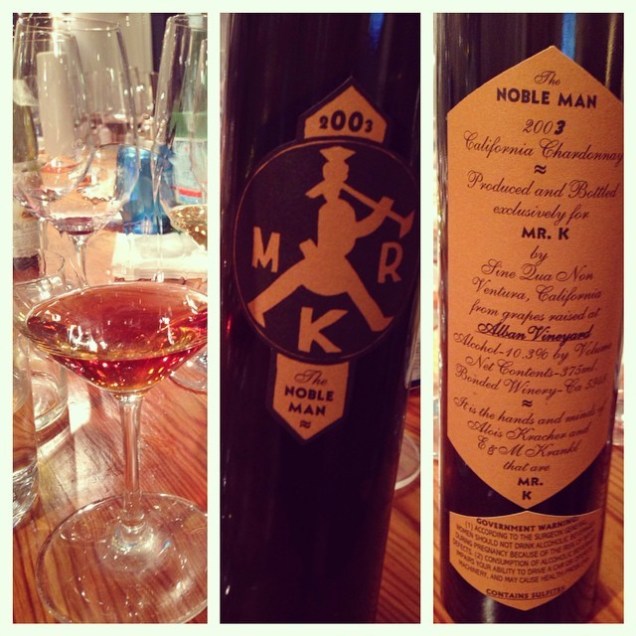
This is a 2003 Sine Qua Non Mr. K the Noble Man. It’s a dessert wine and it’s ridiculous. #feelingluckythiswasshared.
Blind Syrah tastings. (at Domaine Wine Storage)
 It's Wine By Me!