
So excited to finally try @enfieldwineco Syrah! Now the struggle begins to save for a bit or pop and pour! 🍷
So excited to finally try @enfieldwineco Syrah! Now the struggle begins to save for a bit or pop and pour! 🍷
Morgan Twain-Peterson takes us to the Bedrock Wine Co. vineyard in Sonoma, which produces as good a zinfandel as you will find —as well as the perfect answer to the eternal Thanksgiving conundrum.
I stumbled on this article while checking on a Wine Berserkers forum I babbled in last night after opening my first bottle of Bedrock Old Vine Zinfandel. The well-balanced red wine perfectly married fruit and spice and became a wonderful pairing to last night’s pizza. It was one of those moments where I physically had to remove the wine bottle from my line of sight so I didn’t keep pouring another glass. As I commented on an Instagram I posted: #sublime.
Before ever tasting any of his wines, I’ve been interested in Morgan based on his reputation for great wines, hard work, his prolific instagram activity and the the shear curiosity factor: He’s the son of a famed California winemaker. From the tiny glimpse I can see, Morgan’s out working (and as I just read in this story – studying for the Masters of Wine) and putting passion into his wine every. single. day.
But now I have a new reason to appreciate Bedrock wines, especially as a journalist who spent 16 years at a newspaper. You know those old vines? There’s a bit of history in them. As Jay MacInerney writes:
In 2004 he and his father bought Bedrock, the vineyard we’re strolling through today, and it’s a piece of land well suited to an American history buff. Much of it was planted between 1888 and 1895, when it was owned by millionaire senator George Hearst, the father of newspaperman William Randolph Hearst…. Some 33 acres of his original vines remain, still producing grapes more than 100 years later.
And before you wonder whether these old vines really matter (as opposed to new plantings), Morgan has this to say:
There is also a Darwinian element. If a vineyard has lasted through two world wars, Prohibition, and any number of other things, it must be special, or it would have likely been ripped out.
If the bottle of 2013 Bedrock Old Vine Zin I drank last night serves as any indication, it certainly is a beautiful expression of this special place.

Read the full story on Morgan here: This Winemaker Has Been Producing Wine Since Age Five

Last week’s visit to Aldo Sohm was everything it promised to be: a casual, chic vibe; fabulous wine; gorgeous Zalto glasses and delicious food. Sadly my visit was too brief. We stopped in for only about an hour to have a glass of wine (Nebbiolo, for me), some cheese (a selection from Murray’s!) and charcuterie (amazing fennel salami) before going to see a Broadway show.
I can promise my next visit will be much longer. If you haven’t heard about this place, take a look at these recent write-ups:

It’s over. The six-week WSET Intermediate class I took at Capital Wine School concluded tonight with the promised 50-question-multiple-choice test. I was very prepared. I took my time going through the questions, and then I went through the entire exam a second time. Yet, I was still one of the first students to finish (I think I may have been the 4th or 5th one done). The practice tests were only slightly easier than the difficulty of the real thing. The trick with this course and exam: There’s a lot of information to know. Of the 50 questions, there were about a handful I wasn’t confident about. At least three I looked up when I got home, and I now know I got them wrong. But I’m not kicking myself. They were items that I didn’t focus on enough. Funny thing is, some of the items I fretted over were no where to be found on the exam. So be it.
So what now? Results come out in about two weeks, I think. I should feel relieved, but I’m sad. I thoroughly enjoyed each class. Studying wasn’t the boring, frustrating task it was in my high school and college days. I loved reading new chapters, and conquering the practice questions. I loved learning about grape varieties and parts of the world that hadn’t yet crossed my path. And I have a new joy seeing wine labels in a wine shop or while reading a wine list – it’s like I’ve finally cracked a code, or rather, the language of wine.
I knew one of my weaknesses going into this class was communicating effectively about the taste of a wine. And while I still have a way to go, I’m not disappointed that I didn’t conquer it. To really resolve that, it means tasting more wine and trying new foods so I can correctly identify flavors. That doesn’t seem like such a bad problem to have.
Cheers!
Yoga For Wine Lovers
This video has been out for a few years, but I just saw it for the first time last night. It’s quite brilliant. If only I could be as graceful as Harold.
From the Wall Street Journal:
When they could be raising a glass with their friends during their free time, some wine enthusiasts are hitting the books alongside professional sommeliers in order to take a challenging test.
Look! I’m not the only wine fan out there taking wine classes with no idea whether I’ll actually parlay my career toward the wine industry or just keep it as a fun hobby. But unlike the tone of the story’s headline, I don’t intend on taking classes so I can be called a sommelier (besides, I’m also taking classes from a different organization), nor am I doing this for bragging rights. I’m guessing (or at least hoping) there are plenty more people like me than the ego-driven folks the Wall Street Journal assumes in its story. Fortunately, the writer interviews enough enthusiasts who don’t sound like they’re doing this just for the snobbery. And it’s encouraging that many of them found ways to put their new certificates to good use.
For me, these past 5 weeks (tonight’s my last official class until next week when we take the exam), have been an opportunity to widen my knowledge and find ways of becoming a better communicator. I’m desperate for more interesting and intellectual conversations with other wine enthusiasts and winemakers I meet. And the one thing I know from being a journalist: The more information you’re armed with, the better questions you can ask and the more interesting details you can learn.
WSJ has also produced a video to go with their story, which can be read here: Wine Enthusiasts Seek Sommelier Bragging Rights
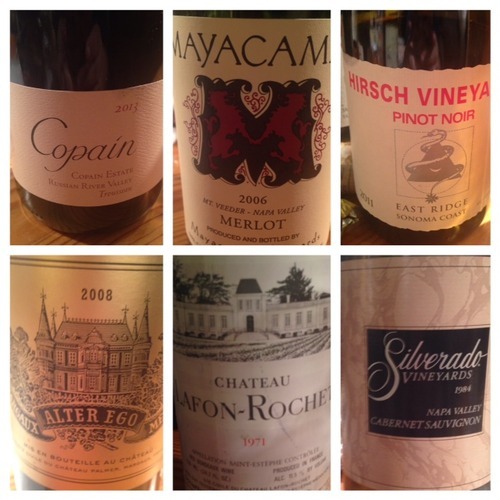
So far today, I’ve sipped the following:
and many others.
I’m not sure how I got so lucky, and I probably shouldn’t have been drinking them today, but I did. And I don’t regret a single moment. My favorite part of wine is the ability to share and it warms my heart that there are people in this world who agree.
It was a fun evening at WSET class last night – ending with a perfect tasting:
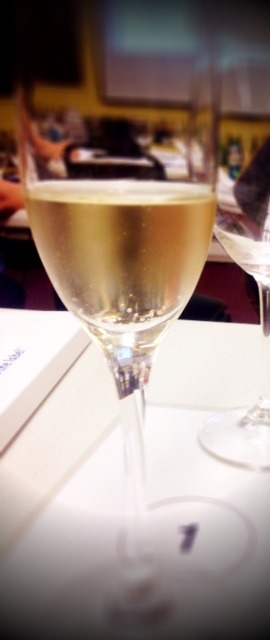
The class mostly focused on red wines: Tempranillo from Spain, Malbec from Argentina, Sangiovese from Italy, Pinotage from South Africa, among many more. But what stole the show was the Champagne we tried as part of the lesson on sparkling wines (and Yes, this is a Champagne from the Champagne region of France): a Billecart-Salmon Brut Reserve Non-Vintage (photo via wine-searcher.com):
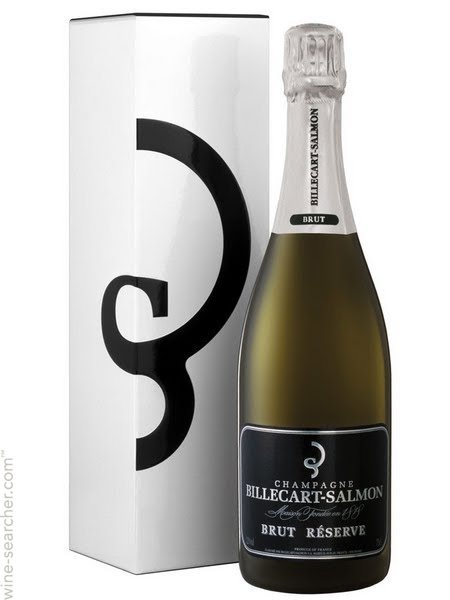
While the instructor gave me a bit of a look when I told him the body was medium – almost all Champagnes are considered light-bodied, I learned – I would argue this is more medium-bodied for what I recall a sparking wine to be. It certainly was fuller than the Prosecco, which we also tasted next. The Billecart-Salmon we had was a blend of Chardonnay and Pinot Noir so many of the pear and apple characteristics popped through its flavor. The bubbles weren’t overwhelming (which for my preference, is a good thing), and those creamy, yeasty flavors that a good champagne promises, were all front and center. A fellow student had a better descriptor: a lemon meringue custard. My mind then wandered to a freshly torched creme brulee as I took another sip, and then another one, and another.
A combination of work projects, studying and diving into a book a friend recommended, has taken my attention away from obsessively monitoring twitter and other online news outlets for wine-specific features. But there are a few things that have caught my attention. I hope you’ll enjoy them, too!

I may have mentioned this already, but I have a hard time with Cabernet Sauvignons. As a California wine lover, who loves visiting Napa, this can be a bit frustrating. Even in blends, when it’s not the dominate grape, I can easily detect its presence.
The reason? I’m not a fan of green bell peppers, and whenever that flavor is present, it leaves behind a terrible bitter taste. No matter how lush the fruit and other flavors that may waft from the glass, just a tiny taste turns the entire experience sour for me.
Fortunately, there have been a few exceptions. I recently had a glass of Stag’s Leap Hands of Time Napa Valley Red Blend, which I gladly accepted a second glass of; and I’ve been able to tolerate some Cabernets when paired well with food.
But it turns out, there’s a name for this flavor – and a reason it’s detected in certain wines. More importantly, I may not be the only one who’s sensitive to it (see this 2010 blog post on the subject). It’s a chemical compound called Pyrazine.
The chemical often appears in Sauvignon Blancs, too. But I’m much more likely to tolerate it there. In fact, I’ll actively order SBs and love the crisp mix of high acidity with citrus flavors and some light herbaceousness. Given my choice, I’ve always enjoyed California SBs to those from New Zealand. And wouldn’t you know it: Pyrazine is more apparent in Sauvignon Blancs from Marlborough than those from California (So why can’t winemakers do the same with their Cabernets?).
I’m guessing there are probably additional chemical reactions that happen in red wine, which make it less approachable for me. I hope to research this further and learn more about it. For now, however, I’m glad I can put a name to it.
(Photo by Manfred Moitzi via flickr and creative commons.)
 It's Wine By Me!