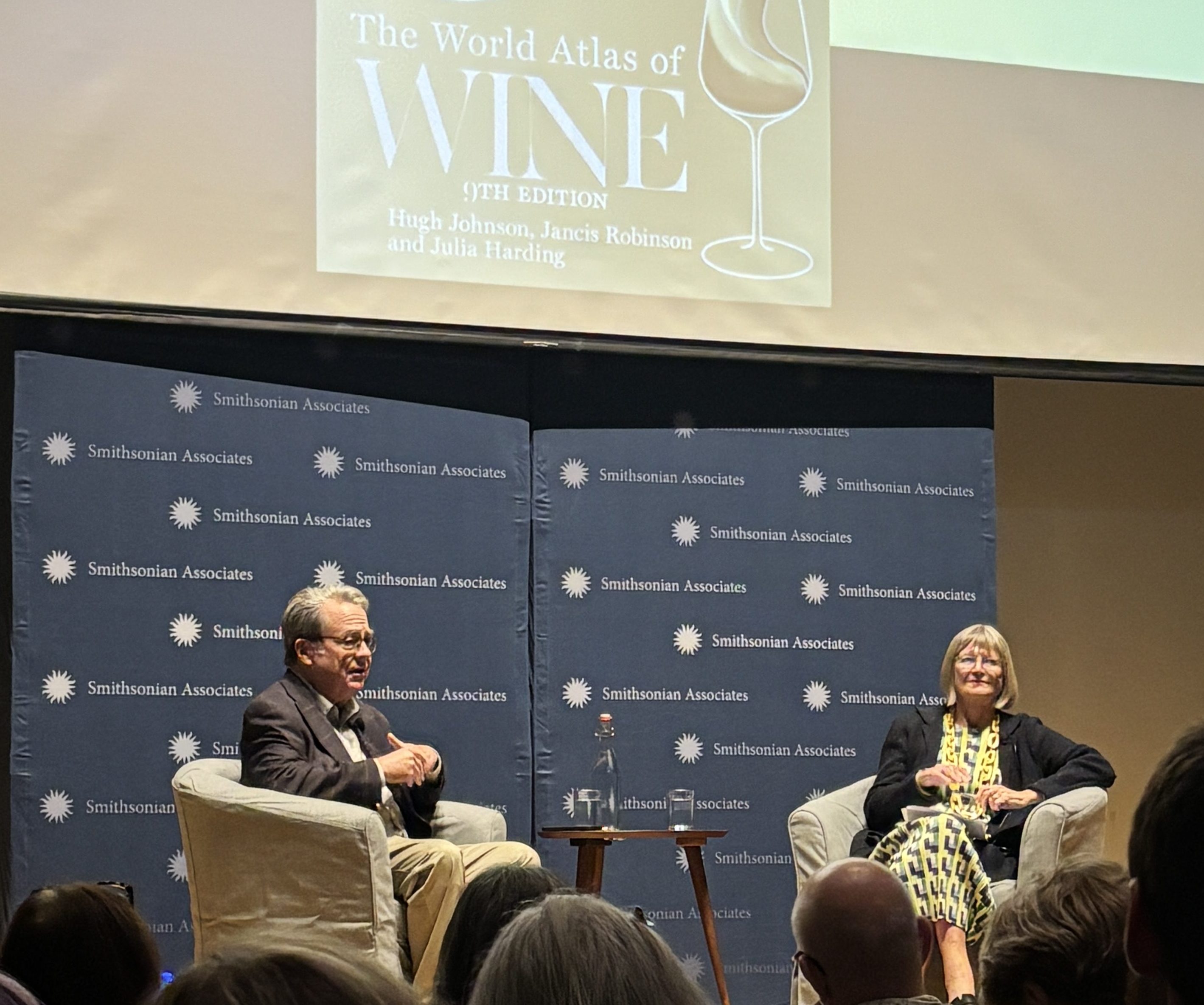
When Jancis Robinson began writing about wine 50 years ago, the wine world looked very different. Today, long-standing assumptions about where grapes can grow, how wineries operate and even the bottles that hold the wine are being upended. These transformations were at the heart of a conversation between Robinson and former Washington Post wine columnist Dave McIntyre during a recent Smithsonian Associates event in Washington, D.C., as the two discussed the newly released ninth edition of the “The World Atlas of Wine“.
Alongside Robinson’s other influential works, “The Oxford Companion to Wine” and “Wine Grapes,” “The World Atlas of Wine” — first written by Hugh Johnson and now also co-authored with Julia Harding — is among the industry’s most respected reference books. Even in a digital age, these books remain treasured resources for wine students, professionals and connoisseurs who use them often to indulge in the details of their favorite bottle.
The Atlas’s ninth edition goes beyond routine edits. Its cover boasts it’s “completely revised” and during the event Robinson pointed to a single driver: “The overriding change is climate change,” she told an auditorium of approximately 150 people comparing the eighth edition (published in 2019) and the ninth.
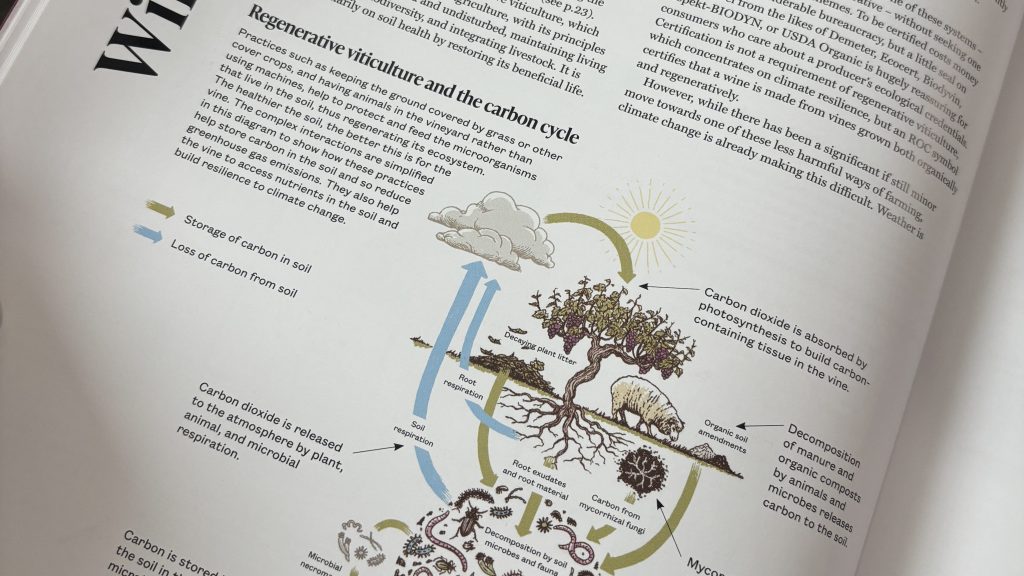
Proof of that is scattered among an additional 16 pages, which include new maps and information about emerging wine regions (the 432-page book now has a total of 240 maps). While flipping through the introductory pages, graphics on the carbon cycle, temperature rise and California’s carbon footprint stood out, underscoring how climate change is impossible to ignore in the industry.
With wine-growing regions expanding closer to the North and South Poles, Robinson highlighted the Atlas now includes new maps of Northern Europe, where she said all of Scandinavia and every Baltic nation are now producing wine. In the opposite direction, she spoke enthusiastically about Chardonnay production at the southern tip of South America in Patagonia. For a book built around the geography of wine, the shifting boundaries of where grapes can grow show just how quickly the industry is changing.
But while the reasons behind these shifts may feel grim (such as wildfires and smoke taint threatening vines or water shortages depriving vineyards — “I’m worried about water, less rainfall and more drought,” she noted), it’s quite remarkable how upbeat and optimistic Robinson remains about some of these industry shifts.
Listening to Robinson discuss other additions to the book (some are not necessarily climate-driven) is like seeing a flashing neon arrow pointing to all the exciting bottles worth seeking out: The ninth edition now devotes maps to Champagne’s Aube region, the “volcanic Loire,” along the easterly reaches of the Loire River in France, and Valtellina, Italy, high up in the Alps near Switzerland. Calistoga, in the northern part of Napa Valley, also gets its own map.
Yet climate change is doing more than just redrawing borders and creating new wine regions: Robinson said these challenges are spurring cross-border collaborations, more innovation and even rethinking which grape varieties can be grown and which wines to produce as the industry works to adapt and become more sustainable and resilient. In today’s world, winemakers are not just seeking to adapt to a changing climate, they’re also trying to reduce their own environmental footprint.
For example, during the talk, Robinson discussed bottle weight, which contributes to carbon emissions both in production and in transportation. It’s been an issue she has long campaigned to reduce. So much so that her wine reviews include an “NHB” rating, standing for “naughty heavy bottle” (which takes on a greater importance if you can hear it in her British accent). As explained in the Atlas, “the energy required to heat glass furnaces and to ship glass bottles is wine’s single biggest contribution to greenhouse gas emissions.” The good news, she said, is that the industry is shifting. “In my time, I’ve seen a delightful revolution,” she said about falling bottle weights.
Robinson also pointed to more global collaboration. She recalled how in the late 1970s vignerons in Burgundy would “feign ignorance” about their neighbors — keeping to themselves while producing their wines. Now, winemakers “have friends everywhere,” she said. “There’s no barriers now between producers,” she said, noting how common it is for winemakers to travel and do internships in other parts of the world. She recalled talking to one Napa winemaker after the 2017 wildfires who said she immediately called an Australian winemaker for help when smoke and fire threatened her vines.
That kind of collaboration will be increasingly important as the wine industry navigates these shifting regions and adapts to a changing climate. Fortunately, books like the World Atlas of Wine can help us keep track of this evolving world.
For more on The World Atlas of Wine and Jancis Robinson’s Washington, D.C., conversation, read Dave McIntyre’s articles about the ninth edition and his own recap of his Smithsonian conversation.

