Of all the social networks, Instagram is by far my favorite way to learn about wine — and probably more importantly, the people in wine. It can be super fun to ogle at bottle shots (I’m certainly guilty of posting many of those) or follow winemakers during harvest, but it’s the accounts that teach me a little something or show off a creative way to look at wine, that I really appreciate. Here are three of the accounts I’m currently crushing on. Leave me a comment with the accounts that make you happy.
Clearing the cellar meant we opened a lot of wine! (Photo by Berg Atkinson)
When you enjoy wine and start to acquire or collect it, it’s easy to fill up your space pretty quickly. And if you’re like me, you often save a bottle or two to share with specific people, or a specific occasion. But then those opportunities don’t quite come the way you imagined, or a bottle gets pushed to the back and you forget about it or your tastes start to change and all of a sudden your favorite wine is just meh.
Chances are, that’s happening to your friends, too. So now that shipping season is here (the few months a year when the weather won’t ruin the wine on the back of a delivery truck because it’s too hot or too cold), it’s not unthinkable to admit that you may have gotten a bit carried away and now have nowhere to put your wine, unless you like making cardboard box towers in your living room.
Too many boxes full of wine with no place to put it. (Photo by itswinebyme.)
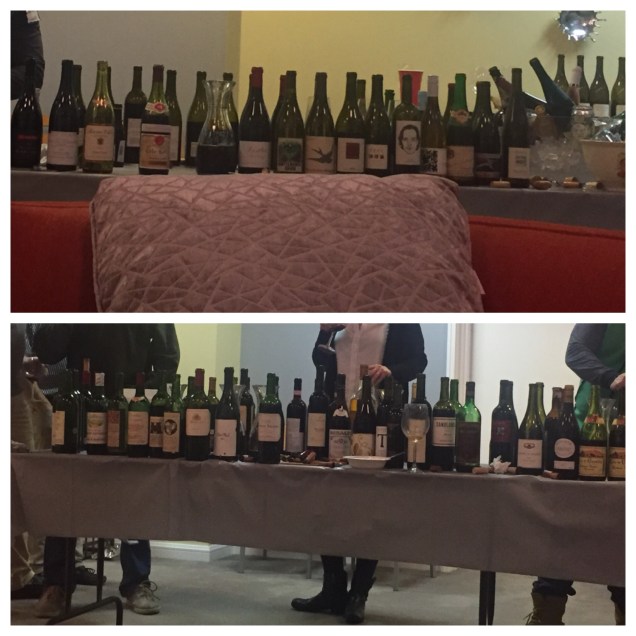
To combat this purely first-world problem, some friends decided to throw a Clear the Cellar Party and invited about a dozen (plus or minus) wino-s to bring a random assortment of wines they wanted to get rid of, but didn’t necessarily just want to pour them down the drain.
We had close to 100 bottles of wine open and probably another 20 that we failed to uncork. The results were nothing short of epic, not so much because the wines were amazing — in fact, many turned out to be just so-so (and there was at least a case of undrinkable wine) yet the diversity of wines and curiosity it provoked made the tasting that much more fun.
Not to mention, there was an absence of stress that often comes with wanting to impress others with the bottles you brought. So, what’s usually a gathering of fun, super laid-back people, was even more relaxed. That translated to more laughs, more fun and an evening to remember.
Want to throw a similar party for your friends? Here are some tips based on what contributed to our success:
* Give guests several weeks notice so they can really dive into their cellars and pull the bottles they want to bring (or maybe locate bottles they are curious about trying — we really had no definition of what “clearing the cellar” should mean).
* Find the right kind of space to throw the party. This is not an event to combine with a restaurant or seated meal. Somebody’s home or backyard will do. My friends reserved the community room in their condo building, pushed several long folding tables together, and it was perfect.
So. many. bottles. (Photo by itswinebyme.)
* When the wines arrive, don’t try to organize the bottles too much. Loosely group them in order from light whites to deep, dark, brooding purple. Don’t push the tables against the wall. Having space to walk on either side of the table meant there was never any crowding.
* Plastic utility buckets make wonderful spit and dump buckets. Our host was diligent about dumping the buckets when they were about halfway full, too. That insured no splashing and no accidental spilling. (Oh, and come to grips, you’re going to dump a lot of wine, and that’s perfectly okay! In fact, it’s the responsible thing to do.)
* Food. You need food to ensure your friends don’t over indulge. We had two big plates of cheese and charcuterie to snack on right away. Then, later on in the evening, some other goodies were served: pulled pork, a chicken dish, brisket and a bunch of sides and salads. We did everything pot-luck style. There was room to sit and eat, but it wasn’t a seated dinner.
* Find a corner of shame. It’s inevitable, there will be some duds. And it will be sad. So once a couple people have tasted the offending the wine and agreed, we banished the wine to a far corner of the room. Yes, it’s heartbreaking to see these bottles here — especially the ones with significant age. But it allowed us to pay our respects, and helped others decide what not to taste.
The beginning of what became the “corner of shame.” Many more bottles joined this group before the night was over. (Photo by itswinebyme.)
* Be really fabulous hosts. I can’t thank our hosts enough for all the hard work they put into planning and keeping things running smoothly throughout the night.
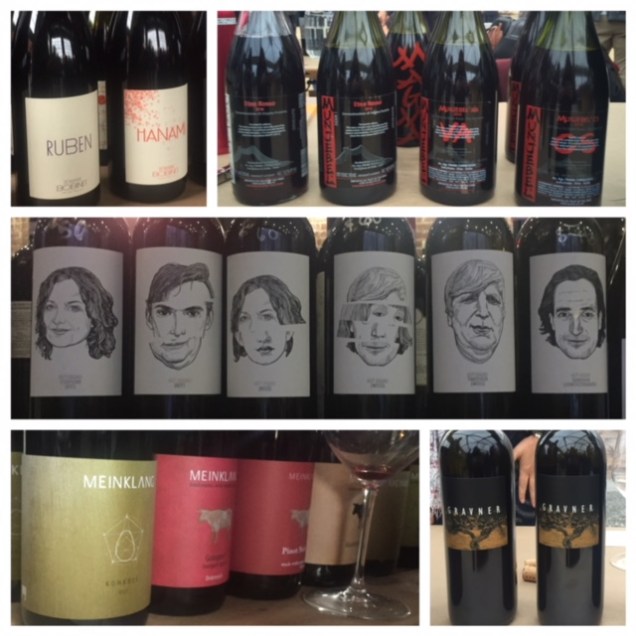
Some of the delicious producers who shared their wines at the Raw Wine Fair.
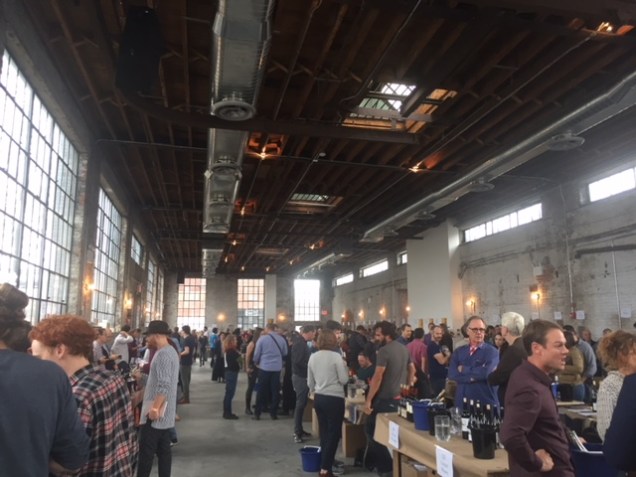
What happens when you put 145 wine producers from all over the world inside a Brooklyn warehouse who all share common winemaking (and growing) values? You get 145 different points of view, often with wild flavors and textures to match. I wouldn’t have expected anything less from the Raw Wine Fair. And neither would the hundreds of wine professionals, industry insiders and enthusiasts who eagerly made their way from table to table, tasting a handful of wines from each producer, using the well-placed spit buckets and overwhelming the winemakers who were proudly pouring and answering questions.
The calm before the storm as people begin to arrive for the second day of Raw Wine.
When I interviewed Raw’s founder Isabelle Legeron about a week before the fair, she told me, “Growers have felt very confident to showcase their wines with us because they knew it wouldn’t be an event where people would be getting rowdy and drunk. They’d be appreciating the wine.”
She was exactly right. Those attending Raw weren’t hogging the stations, or elbowing each other to get in. At busier spots, people patiently waited their turn. Often times, if you approached a crowded table and just motioned your glass nearby, someone would let you in.
These kinds of events are full of discovery and it is not uncommon to discuss with other strangers which producers they find interesting. Toward the end of my time on the first day, I wound up chatting with someone from Boston who took me on a mini-tour of his favorite producers — all of whom I had missed during my own rounds.
Here are a few of my discoveries (and observations) from the two-day natural wine fête:
* As others have said about natural wine — there’s a lot of really beautiful wines. There’s also plenty of not-so-great natural wines in the world. But then again with taste as the ultimate subjective experience, take those words with a shaker full of salt.
* This was a good reminder to throw what I think I know about wine out the window. For example, there were some beautiful wines from Chile — usually a region I shy away from (just personal taste preferences), whereas I was disappointed by what I tasted from Northern Rhone (usually one of my favorite regions).
* It’s possible to grow grapes, and make age-worthy wine in Texas. Unfortunately if you want any of the wine, the only choice you have is to visit the winemaker’s tasting room.
* Fun celebrity sighting: Aziz Ansari. Not completely a surprise as he’s already noted for enjoying natural wine, but as a “Master of None” fan, it was a bit of a thrill to see him up close.
* The power of spitting during an event like this can’t be stressed enough. It’s the only way to actually enjoy all of the wines and be able to leave standing straight and in one piece. Taking breaks to get a bite to eat helps not just with keeping you from getting drunk, but also with palate fatigue.
* I wish I remembered my Spanish, or knew French, Italian, German or any other language. For those producers who didn’t speak English well, it would have been wonderful to converse with them in their language. You could see in their eyes and from the genuine smiles on their faces the love they had for their craft, and it would have been wonderful to indulge in more conversation with them.
So now the fun begins — trying to find these wines in the wild via retailers or restaurant wine lists. Until then, I can at least remind myself of how much excitement and happiness surrounded me in this Instagram I accidentally photobombed while leaving the Gut Oggau tasting table.
Just back from Raw Wine New York. What a fun, crazy opportunity to talk to producers, catch up with folks in the industry, taste and learn! As a result, I wasn’t paying much attention to what’s happening online. But not to fear, there’s still a few good pieces that should be on your radar.
* First, some sad news from Wine Spectator: Oregon Winemaker Patricia Green Dies In Apparent Accident. Known mostly for her Pinot Noir, Patty Green was no doubt a pioneer in introducing Oregon wine. (Read the announcement from the winery here.)
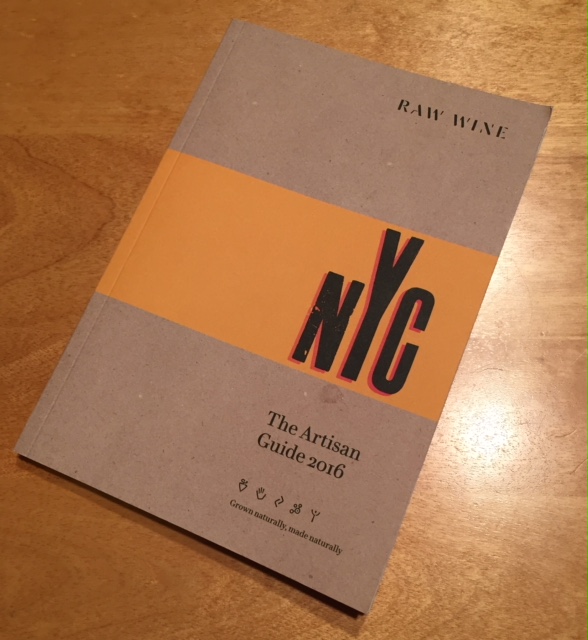
Looking for a way to understand what all the natural wine hype is about? Hundreds of these wines from all over the world will be featured under one roof as the Raw Wine Fair descends on New York and then Los Angeles this month. The tasting brings together more than 100 winemakers from around the world who produce what’s considered “natural” or “low-intervention” wines.
With allthequibbling about what it takes to qualify as a natural wine (and whether that really matters), this event is a good place to learn, ask questions and make your own judgments. (You’ll also be able to keep up with trendy wine conversations after meeting such producers as Sicily’s Frank Cornelissen, Austria’s Gut Oggau and Slovenia’s Movia.)
Conceived by Isabelle Legeron, the first woman Master of Wine in France, Raw began in 2012 in London as part industry-trade show — and a chance for small wine producers to market and introduce themselves to importers, distributors and other wine professionals — and part consumer tasting (last year, was its first visit to the U.S.).
“I want people to start thinking about wine the way they think about food,” she told me last week. “I realized very early on that we have this idea that most people think that wine is natural regardless. People have this idea that wine is grape juice fermented and bottled. And that’s because there’s no ingredient labeling requirements for all of wine.”
The reality is that most wines are filled with enzymes and other additives that are used to help preserve the wine, enhance the flavor, and some — with names like mega purple — can manipulate the color of the wine.
“For me, it’s very simple. A natural wine is made with 100 percent grape juice and nothing else. Not even use of sulfites,” she says. But “for the purpose of the fairs, we’re not exclusively a natural wine fair. Not very many people make purely natural wine. For the fair, growers who are natural, it’s a two stage process where everything has to be done organically: cleanly in the vineyard and nothing added in the cellar. We also welcome low-intervention, biodynamic, permaculture principals. [The winemakers are] not allowed to add yeast or enzymes, except small doses of sulfites.”
The use of sulfites — which helps prevent wines from decomposing as it ages — is usually at the heart of the “what’s a natural wine” debate. Consumers tend to understand it the most, because it’s something they’ve heard of. The chemical is often blamed for causing headaches (that’s a myth!) or causing allergic reactions. Yet, sulfites appear in many foods, and doesn’t quite get the same bad rap.
Producers attending the fair who use minimal sulfites are required to list that information on the Raw Wine website, underscoring Isabelle’s transparency values.
“Because even people who work in a very low-intervention way are way, way more natural than the vast majority of wine producers out there. Somebody who uses a little bit of sulfites, but farms organically, ferments naturally, doesn’t fine, doesn’t filter, is actually on the spectrum of a natural wine producer,” she says.
In the year leading up to the fair, Isabelle tasted wines from hundreds of winemakers all around the world who submitted their bottles for possible entry into the fair. She estimates that only about 20 or 30 percent get chosen.
So what’s the best way of tackling the Raw Wine Fair — especially with 145 producers attending in New York, and 112 in Los Angeles? Remember, each producer could have up to five or six different wines to try. Isabelle stresses it’s about interacting with the growers more than anything else, and of course spitting.
If you’re a consumer, Isabelle suggests this:
“People need to come in and really enjoy the experience and make sure you spit, that’s the first thing. Make a whole day of it. Take breaks, have a bite to eat, have a coffee and maybe not view it as a marathon. More look at it as an opportunity to chat with growers. Even when you’re trade, it can feel a bit daunting … It’s not technical. We’re not here to score wines or anything. We’re really here to communicate a way of living. A way of somm’ing, a way of making wine. Don’t taste with your head, but taste with your stomach and your instinct.”
And for the winemakers:
“For the growers, my advice is always to be super friendly and super smiley. Because I think sometimes producers come from very far away, some people speak not the best of English, they’re a bit shy, they’re a bit worried about are they going to say the right thing, but I always say to them, they’re just here to meet other human beings, and not get too bogged down on the technicality unless people specifically ask for it, because what most people want is to meet the grower … it’s the human interaction.”






 It's Wine By Me!